Sabtu, 21 Januari 2017

Seat Blocking Kind Words and a Testimony

Seat blocking & angle finder


My planer / jointer & a bunch of shredded mahogany

Seat Blocking?
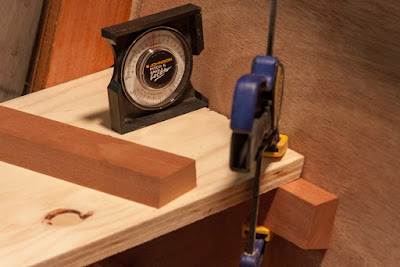
Yesterday, I made the 2 pieces of blocking that will go under the ends of the rear thwart. Thanks to my angle finder, I knew the bevel on the blocking needed to be 15°. I cut that bevel by adjusting the fence on my planer / jointer, and running the pieces of mahogany (roughly 12” x 2” x 1” each) over it a few times. Everything looks like it should fit just fine. I’ll trim the pieces of blocking down about a half inch or so, before actually installing them. 

The next step will be to remove the seat and attach some reinforcing pieces to the bottom, in an effort to straighten out the slight bend in the plywood. 

Kind Words
?Earlier in the day yesterday, I had attended a funeral mass for a friend’s mother. I’m not very familiar with Catholic services, and I was sitting in the back with others who weren’t really sure when to sit, stand, or what words to repeat. Some people can feel pretty uncomfortable about that, but I find the awkwardness a little fun. Some of the rituals of the mass were similar to Episcopal services I’m more accustomed to, so it wasn’t entirely foreign to me. But ultimately, such ritualistic expressions are not the main point. “Religiousness” and “faith” are two entirely different things. 

That was on my mind as I walked through the narthex, greeting old friends… many of whom I haven’t seen in a long time. One of them, who knew a bit of what I’ve been through as far as divorce, heart surgery, and other things, spoke the kindest and most affirming words to me that anyone has ever spoken. I was entirely humbled by the man’s eloquence and consideration. I was not worthy of it. 

What totally floored me was when he said that, whenever he faced difficulties or hardships in his own life, he thought about me; that in doing so, he found inspiration in separating what really is, and what really is not, worth worrying about. I was speechless. I was even more speechless when he gestured toward the altar, with the crucifix on the wall above it, and said that he had no use for the supernatural, but instead found inspiration in other people. I understood, because I knew that my friend is a devout atheist… Just as I professed to be for the majority of the time he & I have known each other. 

What changed? 

I thought of the words of Peter: “Be prepared to give an answer to everyone who asks you a reason for the hope that is in you.” All I could do was gesture back toward the crucifix on the wall. 

A Testimony
Don’t worry. This is a boatbuilding blog, and not a platform for proselytizing or shoving religious agendas in anyone’s face. Of all people, I completely understand how irritating that is. I just wondered, how would I share with my friend who I admire and respect, the reasons I had gone from sharing his very same viewpoint to the one I hold now? 

For one, there is this: Most atheists I know are very sensitive to notions of right and wrong, and are almost all advocates of kindness and social justice. From a humanist standpoint, I began to ask myself, “Where do all these sentiments of knowing good from bad, right from wrong, come from? How and why are these sentiments so innate in most people?” 

You may have also heard the expression “there’s no such thing as an atheist in a foxhole.” True enough… when most people are pushed to points of absolute desperation, why do they say phrases like “please, God… don’t let this be.” Is it only an expression? If so, why is it so instinctive, even for the non-believer, in those most desperate moments? 

Also, I began to question why I had such a disdain for religion. After a lot of honest self-examination, I realized that I truly did not have a problem with a God… if there was one. Instead, I had a general disdain for “christians.” You know — those hateful, rude, self-righteous people who express their moral superiority over everyone else & tell the rest of the world they’re going to hell. Those people. 

I have come to believe that “those people” with “that attitude” have done FAR more to alienate people from faith than they have done to share it. 

So, at a point in one of my darker moments during the early stages of my divorce, I made a decision. I decided I would discard EVERYTHING “those people” EVER told me about God. I decided to discard every sermon, from every denomination…. every shaking, judgmental finger that had ever been pointed at me. I jettisoned it ALL. 

I realized that, throughout much of human history, during times of the most corruption and evildoing in the name of God, “the church” held the power of one particular point of leverage over common people: Literacy. 

Much of human history has been filled with unwritten, average, everyday people who could only dream to read. These people had to rely fully on “the church” to explain the words of the bible. With the power of literacy and the fear of a wrathful God in their hands, “the church” gained an almost absolute power over common people. 

Today, we largely take literacy for granted. I realized that my impression of faith had largely been based on what I had seen and heard from “those people,” and NOT what I’d read for myself. My impression of faith had also been formed by things I’d heard and read from vociferous opponents of religion, and what THEY had to say about the bible…. NOT what I had read for myself. I had absorbed everyone’s opinions but my own. Maybe it had just been easier that way. 

In any case, I decided to change it. 

I discarded everyone else’s interpretations, explanations, and opinions of the bible. I bought one, and simply began reading it. It was a turning point. 

Have a great day.
Read More..

A kitchen scale saves the day

I took another boatbuilder’s suggestion, and bought a kitchen scale to use in measuring my epoxy mixtures. This simple device I bought for about $30 at K-Mart has made a huge difference. I can now precisely measure any given amount of epoxy, with no guesswork. It’s such an obviously superior method that I wish I’d done it this way all along.

Not surprisingly, the last 2 layers of epoxy went on easily, with no problems whatsoever in curing time. With the stem & related parts now encapsulated, I could move on to finishing the side planking.

On February 15, the 1-year anniversary of my heart surgery, I got the forward starboard planking attached.

Again, the kitchen scale was an indispensable part of the process, and really saved my tail at one point. With weight-based measuring, the Silvertip Gel Magic is mixed at a 1:0.41 ratio, (rather than the 2:1 ratio by volume.) I had mixed a little over 150 mL, because I had a considerable amount of area to cover: both surfaces of the butt joint, the forward 7 feet of chine and sheer, the side of frame #2, the upper part of the stem, and all the same mating surfaces on the planking itself.

I ran into trouble about 3/4 of the way through this batch of epoxy. Enough time had elapsed that the mixture had become so viscous that it was unworkable. At that point, I had coated everything on the boat framing, and had only just coated the mating surface for the butt block on the planking. I had all the rest of the planking left to go.

Luckily, I had 1 extra mixing cup and 1 extra chip brush on hand. Going quickly back to the kitchen scale, I mixed a small batch of approximately 75 mL, allowing me to finish the job. The epoxy cured solidly by the end of the afternoon.

The next day, I faired off the front of the starboard planking at the stem, and started fitting the port side.


Starboard side planking, finally attached!
Now to fit the port side.

Read More..

Jumat, 20 Januari 2017

Camping as Space Travel


Camping is often lauded as a way for harried urbanites to re-connect with nature.  Well maybe. Decades ago, I used to go on canoe trips to Quetico Provincial Park in Ontario, Canada, sometimes with friends and sometimes with family.  To do these trips, we had to pack all the food we would need for the length of the trip.  Not packing enough food would mean going hungry since there are no stores in the park.  Then at some point, I took along a fishing rod and caught fish to supplement our meals and surprisingly, my experience of the camping trips changed.
The best way I could describe the new relationship was that it no longer felt like space travel where you had to bring absolutely everything with you that you needed to survive.  Once I was able to catch fish, my environment took care of some of my needs.  I was not entirely reliant on my environment to provide me with food, but I was not entirely reliant on what I had brought with me either.  I felt a new bond with my surroundings.  My surroundings now provided for me.  My presence in the wood and lake country was in a sense approved of by my environment.  I could say that I now filled an ecological niche, that of a fish eater.  I was no longer simply a tourist on a life line that led back to the civilized eco-niche that I had come from.
Yes, I was by no means living off the land simply because I caught a few fish, but the fact that the land I traveled through provided me with at least a part of my sustenance changed my relationship with it.
Camping in Kings Canyon, NP.  The yurt dwarfed by tall pines and the canyon wall.
Fast forward to the recent past.  My wife and I spent a few weeks camping in the Sierra Nevada mountains of California.  We started out at Kings Canyon National Park but were kicked out because of the government shutdown.  After expulsion, we moved on to the Sequoia National Forest where they allow dispersed camping, that is, camping somewhere other than at a designated National Forest campground.  We were now entirely on our own for amenities since the NFS wasnt providing any.  That is, other than a spot to park your car and pitch your tent, the forest service wasnt  providing anything, no toilets, no water, no garbage cans, no bear boxes, no pavement, no wood. Worse yet, because of a prolonged drought, we could not build fires either. We had to stick with our propane fired camp stove.  We were able to manage without toilets and had enough drinking water to get us through a few days at a time before needing to replenish.  But in a way, we were back in space travel mode.  Absolutely everything we needed to survive had to come out of our space module, the family car.
The yurt after our relocation to Sequoia National Forest. 
Not that camping in a  National Park was any better.  If anything, under normal conditions, it was even more restrictive and artificial an experience than camping in a national forest.  In a national park, you are not supposed to interact with the environment in any way.  You cant burn the wood, you cant pick the plants.  You cant hunt the animals, nor feed them, though apparently, you can do some fishing where there are fish.  Mind you, I am not criticizing National Park policy.  I am simply stating the effect it has on the experience of being there which is that it is not meant to be an environment that will support human life. It is an environment that tries very hard to minimize human impact. Any self sustaining activity other than fishing is in effect prohibited.  To return to the space travel metaphor, I dont know whether Star Trek with its prohibition of modifying alien cultures came up with this idea on its own or got it from the National Park Service, but there we were, camping without modifying the environment.  For the most part, its great to be in a national park because they manage to preserve the landscape in a state that resembles the state it was in before Europeans showed up.  That is, besides some of the most stunning scenery, you also get to see what trees looked like before people cut them all the big ones down.  And unlike the national forest, nobody is using the national parks as cow pasture.
So far I havent even mentioned backpacking.  Backpacking gets even closer to space travel than car camping.  For backpacking, at least the way its done these days, you need all sorts of specialized gear that you can only get in a high end camping store.  Everything needs to be light weight, including your food which resembles the food of astronauts.
But you can still have some sort of camping experience that doesnt resemble space travel if you are willing to be creative and accept the fact that you cant have humans invading an environment without having some impact on it.

Read More..

Kamis, 19 Januari 2017

The aft port side panel is now attached. I followed exactly the same procedure as for the aft starboard panel, except this time I did remember the rag.

I decided to go ahead and rough-fit the forward panel on the starboard side. First, I marked and cut one of the Meranti panels in half lengthwise, giving me two 2 x 8 panels to use for the side planking.

Using one of these panels, I began to fit it to the starboard side. I had to go through several cycles of "Clamp, Mark, Remove, Cut, Repeat" in order to cut away extraneous material from the front of the panel. This was due to the low height of the construction form. For several attempts I could not bend the plywood all the way around to the bow without the floor getting in the way.

Finally, I got it roughly fit & it is now temporarily clamped into position. Once Im satisfied with the fitting, I will check the starboard panel against the port side. If everything looks like a suitable fit, I will then use this panel as a template to mark and cut the second panel from the other 2 x 8 piece of plywood.


So far, Im pretty pleased with the Meranti. It is a nicer-looking wood than I expected, and it seems to bend much easier than the Douglas Fir plywood.

Forward panel rough-fit & clamped into position on the starboard side.


Read More..

Basic Technology by Michael Wolf

Michael Wolf is a photographer working out of Hong Kong and possibly other cities.  A while back I ran into his photos of what he called "Bastard Chairs."  I would have picked a more flattering term, but bastard chairs is probably what most people would regard them as.  In any case, these chairs are what you get when people who are not professional chair makers improvise on chair repair.  They are in a sense, folk technology.  Go to the link http://photomichaelwolf.com/#bastard-chairs/1 to see more examples.
Housing is another area where folk technology proliferates.  And Michael Wolf has done photographs of that as well in a photo group called The box men of Shinkuju Station.
How does this relate to skin on frame kayak technology?  Well, given a need, people will invent a way to make do with what they have.  That is the essence of most primitive technology.  In our own very compartmentalized world where everything has to be done by experts we are usually isolated from folk technology and instead overwhelmed by what we commonly think of high technology.  But inject poverty and take away the money that it takes to fund the expert technologists, voila, up pops folk technology like mushrooms after a rain.

Read More..

Sabtu, 14 Januari 2017

It is one thing to see wood at a lumber yard and it is quite another thing to see it in the form of a living tree.  Unlike the stuff in the lumber yard which gives little evidence of where it came from, the living tree obviously speaks for itself.  It is not a product but an individual being with a considerable amount of character that makes it distinct from others of its kind, especially when old.
The musings I am about to deliver on the nature of wood were prompted by a trip to Kings Canyon and Sequoia National Parks.  The two parks are adjacent to each other, with Sequoia to the south and Kings Canyon to the north.  The only way to approach these parks by car is from the Central Valley of California.  Kings Canyon is adjacent to the city of Fresno and Sequoia is adjacent to the city of Visalia. Giant Sequoias can be found in both parks, although Sequoia National Park has more of them. Coming from the Central Valley which is flat and almost devoid of trees except for fruit trees in the orchards, it is hard to imagine that one is about to enter a mountainous zone where the huge sequoias live. 
But on to some pictures. I would like to say off the start that it is impossible to convey the massiveness of these giant trees in photographs.  The best one can do is show part of the tree with a human or two next to it for scale.  But even then, the photograph cannot capture the sense of presence that these large trees convey. Nevertheless, here are some photographs.
This trunk of a Sequoia has been hollowed out by fire and decay and so it is possible to walk through and along the trunk. 
 
Here is another sequoia that has fallen.  Someone cut a hole through it that one can walk through. The hole by the way is about seven feet tall.

Here is a picture of the tree named the General Sherman.  This is the worlds most massive living being.  It is suspected that some of the trees cut down when logging first began were larger than this, but General Sherman is currently the largest individual.  Its diameter at the base is in excess of 30 feet. 
 

 And here is the root ball of a recumbent sequoia, 30 feet from side to side.
 And using a deer for scale.
 And more humans for scale.
 And a tree hugging human for scale.
Even the branches of these trees are huge.  This one fell off a tree and the park service left it laying where it fell to give people an idea of their large size.  The largest branches on the General Sherman are about 7 feet in diameter.


The sequoias are not the tallest trees in the world.  That distinction goes to the coastal redwoods.  Neither are they the oldest trees. That distinction goes to the bristlecone pines of the White Mountains, one valley to the east of the Sierra Nevada.  But the sequoias are the most massive trees. Their trunks seem to be columns of almost constant diameter rising some 300 feet into the air and then seeming to end abruptly in the older specimens.  

Someone took a slice of a sequoia trunk and propped it up at an angle for the edification of the public. This slice represents roughly 2000 years of growth.  Age is determined by counting the annual growth rings.  The age of standing trees has to be estimated because there apparently is not any equipment that can remove sample cores of the requisite length, roughly 18 feet needed to count all the rings from the center of the tree to its edge.

 This is a side view of that specimen.


And here is a closeup of the growth rings in that slice.  The top of the picture is closer to the center of the tree where the older wood resides.  The crack running horizontally through the picture is a fire scar.  Moving downward toward the crack, the growth rings get ever closer together, an indication of ever diminishing growth.  After the fire, there is an explosion of new growth that again diminishes over time.  Apparently, fires burn the vegetable matter on the ground and release nutrients into the soil which spur new growth for a few decades until most of the nutrients are once again tied up in vegetable matter until the next fire comes along.  Also, note the little circular impressions just above the crack.  These are probably cores taken for carbon 14 dating and then plugged. 
When botanists try to estimate the age of trees based on diameter, they look at slices like this one and try to get an average count of growth rings per inch since as this picture shows, ring density changes with every fire and also with annual precipitation.

There was no sign indicating what sort of wood these park benches were made out of, but I suspect that they were made of sequoia wood. Yes, they haven;t stopped logging sequoias.  Not all of them are protected. Some of them are on private property and some of them are in national forests which are administered by the US Department of Agriculture which regards forests as cropland meant to be harvested. Not an editorial comment by the way. If we want to make stuff out of wood, we have to cut down trees.  More on that at the end.

Here the park service has done a prescribed burn or someone dropped a cigarette. In any case, not much damage was done.  For a long time, the park service used to suppress fires but found that periodic fires are better than monster fires fueled by debris on the ground that has accumulated for too long.  Also, they found that sequoias will not reseed very well without fire.  Fire turns vegetable matter into ash, releasing nutrients for the seedlings to grow.  Fire also kills off young trees that would otherwise shade out the new seedlings. And fire also opens up the cones to release seeds.  So now the park service does prescribed burns which do little damage but reduce the amount of fuel that could produce more dangerous fires.

This picture shows young sequoias coming up with the older fire scarred sequoias in the background.  The ash and the light also allow ferns to grow.

Another view of the burned ground.  Yes the ground burns since the top six inches are a compacted mass of needles and small branches.
Almost every old tree shows fire scars. As a matter of fact, I have never seen so many burned trees as I saw in Kings Canyon National Park.  In the national forests, fire scarred trees are more rare since those are logged over on a more regular basis and fires tend to be suppressed because the trees are regarded as a crop, not a part of an ecosystem in which fire plays a beneficial role.
This is a side view of about eight inches of fibrous sequoia bark which lacks resin and therefore does not burn readily.  Bark on sequoias can be up to two feet thick and this is what lets them grow old in an environment where fires occur naturally every seventy years or so.
Here the fire burned into the trunk of the tree but the segment at the left is still alive.  Every yearn the bark spreads sideways to cover over scars and in time will cover them completely.


Here is a segment of  a branch. The heart wood is red and the sap wood is a lighter color.  The heart wood of the tree is dead.  The sapwood is the part of the tree that is still alive and growing and is where the tree adds more wood around the outside of the tree under the bark. For purposes of lumber we want heart wood because the sap wood decays more readily.
So I was curious what kind of wood sequoias are made out of or perhaps more properly, what kind of wood they grow.  Right on the ground near this broken branch above I found a small piece that had broken off when that branch came down.  It was red in color like that branch but on carving some off, I found that the red color was mostly a product of weathering and that the wood was a lighter color.  It was also surprisingly light, similar to redwood but with a consistency that felt more like cedar.  And then it occurred to me, why not?  If you are going to grow large, why not build yourself out of light wood.  Since most of the weight of the tree is in the trunk, the lighter it is, the larger you can build it.  Sequoias and other conifers dont have huge spreading branches like oaks and so most of their strength is needed to resist the compression of the mass that piles up on top of the roots, mostly in the trunk.  Hardwoods like oak on the other hand that put out large lateral spreading branches need stronger wood to resist bending forces and stronger wood is heavier.  And so boat builders like conifers because they produce long straight trunks that can be cut into long straight boards.

As a boat builder I use wood. And as a paddle maker I also use wood, especially wood from older trees since they are the ones that have the wood that is clear of knots. But to use wood without a knowledge of what happens to the forests where that wood is taken from is akin to buying a pork chop in a supermarket without knowing that one needs to kill pigs in order to make that pork chop.
The impact that the visit to the sequoias had on me was to see trees as individuals.  Young trees a few decades old, especially in large quantities tend to be rather similar in appearance and lack distinction as individuals.  Every tree seems to look like every other tree and so one can more readily regard them as a crop to be cut for use as lumber.  Old trees however, tend to be distinctive, each one different from the next and since in the case of the sequoias they may have been around for perhaps two thousand years or more, one is forced to realize that cutting one of those trees for human use deprives the rest of the world from the presence of such old trees for another two thousand years.  And so it seems that to cut such old trees is rather frivolous because the gain in lumber does not make up for the loss of the presence of the individual.  
And yet, as a wood worker, I use wood.  And since I make objects for other people, I want to give them a good product free of flaws and blemishes.  I want to give them something that looks like wood is something that is extruded by a machine. 
Perhaps I need to rethink my approach.  If I do not want to participate in the cutting of old trees, then perhaps I need to figure out a way to make paddles from younger trees whose wood is not quite as perfect and blemish free as that of older trees.  Stay tuned, I have some younger trees in mind that I will experiment with


Read More..

Jumat, 13 Januari 2017

Drawing out the next major Zip part

At first glance, the Zip has some rather odd frame designations.... Specifically, frame number "5-1/2".

It seems odd until you understand that the designations are logically based on boat design drawings. If you look at a cross-section drawing of the boat, there are several vertical lines that divide the hull into sub-sections. Each one of these vertical lines is called a "station." The numbering starts at zero (the transom), and ends at "F.P." (which stands for "Forward Perpendicular") at the foremost tip of the boat. In the case of the Zip, there are 8 stations including "F.P.", dividing the hull into 7 sub-sections of about 24-1/2" each. Frame # "5-1/2" is the frame placed between stations 5 and 6. It is located near the base of the stem.

Frame number 5-1/2 is a very important part. As the instructions indicate, the horizontal line formed by the floor member of frame # 5-1/2 is the plane from which the rest of the boat is set up. The instructions specifically state to take extra care to ensure that this part is accurately measured and constructed.

I just finished drawing this part, and I thought it would make a good blog post to illustrate how the Glen-L plans are copied to the wood.

First of all, you fold the carbon paper in half, so that the lines you trace through it are transferred to both the wood AND the back of the actual plans. Then you place the plans on the wood, and flatten them down securely. Push pins help for this.

Secondly, trace the plans for the part you want to build. As I mentioned in an earlier post, the centerline is THE crucial reference point for the boat. ALWAYS carefully draw the centerline. Make sure you extend your traced centerline beyond the needed dimensions of the part, for this reason:

Third, draw "sight holes" that are centered on the extended part of the traced centerline. I like to trace a small coin for this purpose. Use an exacto knife to cut your sight holes through the paper. Youll need these holes to align the plans after you flip them over.

Here Ive traced out the floor timber, and have cut sight holes on the centerline.
Next, remove your push pins, plans, and carbon paper from the wood. The half-width of your part should be clearly visible.

Half-width of the floor timber drawn onto 3/4" Douglas Fir marine plywood.
Now, un-fold the carbon paper, and place it normally onto the wood where the second half of your part is to be drawn. Flip the plans over, and youll see the carbon-copy you made on the back of the plans. Carefully and accurately align the sight holes on the extended centerline that is traced onto the wood. Again flatten the paper down securely. Now youre ready to trace the second half.

Plans flipped & aligned. Ready to draw the second half of the floor timber.
Trace the carbon-copied lines onto the wood, just like you did the first side. When youre done, the full part will be drawn onto the wood.

The full floor timber drawn onto the wood, waiting to be cut out.

Read More..