Rabu, 14 Desember 2016

Sausalito Houseboats and Rowboats

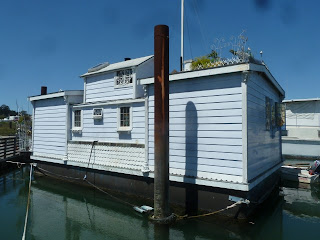
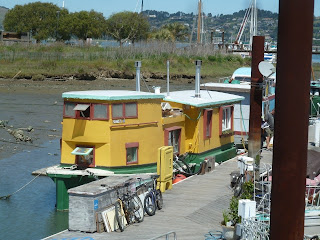
A woman who will be building a kayak with me gave me a tour of her housboat community in Sausalito.  I took some photos of the houseboats and a few of the rowboats docked near the houseboats.  The nice thing about a rowboat next to a houseboat is that in the morning you can get some exercise without going to the gym.
Not much to comment about here other than that the houseboat community seems to have arisen sometime in the 60s.  Some notable folks have lived on housboats in Sausalito, among them, Alan Watts, a popularizer of Asian religions and more recently, Steward Brand, publisher of the Whole Earth Catalog.  All these names used to be household words back in the seventies.  More recent arrivals to this world may have to google them.  So without further ado, photos of houseboats --
One more thing.  I should mention that there are several groupings of houseboats in Sausalito and this is just one of them.


Some housboats are boats.  This one used to be the Mare Island ferry.
Some houseboats like this one have floats.
The quonset hut.

And this one would be at home in town with a lawn out front.

And this one looks like a tugboat expansion

And some rowboats

This is a model that students build in a class.  Each student gets to take home their model.  And all students also work on the full size boat pictured below.  I assume they get a ride in it when its done.


This pram was just sitting there at a boatshop.
 

The boats above are famous designs whose names I was told but promptly forgot. But to my credit, I recognized the names. You would probably as well.
This one just looked bright and cheerful.
And one more cheerful set and then we have to go.
Read More..

Selasa, 13 Desember 2016

Stegosaurus Boat Construction

Ben, my neighbor at the shop is building a motor boat. The process of boat building is a great deal easier than it used to be due to CAD files and NC routers. The long and the short of it is that you no longer need drawings from which to build a boat.  The shape of the boat parts is contained in a file that can be downloaded to a numerically controlled (NC) router that cuts not only the molds but also the frames and bulkheads that make up the boat.  Once all the molds are routed out, they are assembled in a manner that resembles one of these stegosaurus models they sell in museum gift shops.

 Once you have all the molds and frames assembled, you are ready to glue the permanent components together.  After that, you cover the whole thing in plywood and then in fiberglass and epoxy resin and you have yourself a boat.  No lofting and other traditional unpleasantness.
The view from the rear.  Note the cramped quarters.  Luckily, Ben has all of his machinery on wheels so he can roll it out of the way or into position as need be.

Three quarters view from the rear.  The plywood stays in the boat and the stuff without grain is temporary molds and gets removed.

The view from the front of the stegosaurus.


Read More..

Senin, 12 Desember 2016

Glass applied now to fill the weave

After three sessions, the hull now is completely covered with 6 oz glass.  I still need to squeegee on two more coats of epoxy and then some sandable filler to smooth out with the long board.  But, pleased with the progress.  i will need to wash the epoxy blush off prior to filling the weave as the port side has sat for over a week and has some evidence of blush.

transom recieves its glass.  Light spots are filler to fair the tape at the seams. 


Christos was here!


Read More..

Sabtu, 10 Desember 2016

Iqyax Baidarka Flexibility Revisited

One more time now. Back to the topic of what makes baidarkas flexible and why one would make a baidarka flexible. This I hope to be a definitive treatment of the topic, by me anyway. 
I touched on this in a previous post prompted by a visit to the Phoebe Hearst Museum of Anthropology at the University of California in Berkeley. What I discovered on that visit were a bunch of modification to the Atkan Iqyax^ in the museum collection, apparently made to reduce the flexibility of its frame.
There are some accounts on the topic of flexibility that indicate that the Unangan builders tuned the flexibility of their iqyan to suit conditions.  High flex iqyan were built for rough water conditions and low flex iqyan were built for smooth water conditions.  The flex of any given iqyax^ couldnt be modified on the fly but as the frame in the Hearst museum indicates, flex of a flexible iqyax^ could be reduced by modifications to the frame when the skin was off.
On a related note, Father Veniaminov commissioned the building of an iqyax^ with bone shims in Unalaska roughly 200 years ago when there were still people who knew how to build such boats.  His informants told him that the shims increased the speed of the boats. When he tested the iqyax^ with the shims, he found that it was no faster than an iqyax^ lacking the shims. But even though the test was inconclusive, it may be that he tested the boat only in smooth water conditions where the shims would offer no advantage.  In addition, we do not know if his builders tuned the flex of the commissioned iqyax^ to take advantage of the shims.
So without further ado, on to the details of how to tune the flex of an iqyax. Let us start with a picture.
The picture shows two aspects of the iqyax^ frame.  The top frame is shown in roughly neutral position such as the iqyax^ would assume on flat water.  The bottom frame is shown in flexed position with the ends pushed up such as it might look at the bottom of a wave trough.  Not shown is the frame with the ends flexed down, a configuration the frame would assume when going over the crest of a wave.
The important thing to note is that the keelson is slightly curved in the relaxed position. Flexing the keelson more as in the bottom picture would move the tail fin and bow assembly closer together, closing their respective gaps between them and the deck end cross blocks. Likewise, if the ends of the frame flexed down, the keelson would straighten out and the tail fin and bow assembly would move away from the deck, increasing the size of the gaps.
The question for the builder is how to tune the flex.  Should the kayak in the neutral, unstressed position have gaps at the tail fin and bow assembly or should they be tight up against the deck cross blocks?  My guess is that for optimum flex, there should be about a half inch gap both at the tail fin and bow assembly in the neutral position.  This allows flexing of the keelson upward and downward.
If there is no gap in the neutral position and the ends of the keelson flex upward, the keelson would exert pressure on the ribs and flatten them, thus distorting the hull.  If the gap is there, the keelson ends can flex up and close the gaps without distorting the ribs. 
The parts of the frame are joined in such a fashion that the keelson, the bow assembly and the tail fin are all lashed or pegged together tightly so that they act as a single unit. That is, the parts of this assembly do not move with respect to one another.  The keelson is lashed to the ribs, however, the ribs are loosely set into their mortises so they can pivot forward or backward as the keelson flexes.  Also, the tail fin is slotted into the back of the rear cross block but is free to move forward or backward.  Likewise, the rear deck stringer is not lashed to the tail fin to allow it freedom to move forward and backward.
At the bow, the bow assembly joins the deck.  The deck plate joins up with the ends of the gunwales but like the tail fin, can move forward or backward, opening up a gap in the process.
 
The picture shows the gap between the end of the deck on the left and the bow plate on the right.  The deck stringer has been lashed to the bow assembly, a modification to limit the motion of the bow assembly away from the end of the deck.
The notch in the tail fin mates up with the tail cross block.  The lashings between the tail fin and the cross block are an add-on and limit the ability of the tail fin to move forward and backward.
 
This picture shows one of the two lashings that join the tail fin to the keelson.  This joint is quite rigid so that the tail fin would move with the keelson rather than sliding back and forth on the keelson.
So to recap, to build a flexible iqyax^ the key is to allow the tail fin and the bow assembly to move closer to or away from the ends of the deck as the keelson shortens as it is flexed or lengthens as it is straightened.
To allow internal movement of the frame also requires the cooperation of the skin.  If the ends of the kayak are to move in and out, the skin must have enough stretch to allow this motion.
Modern synthetic skins may or may not have enough stretch to allow motion of the frame.  Also painting the synthetic skin with a sealer that penetrates the skin tends to glue the skin to the frame, essentially preventing internal motion of the frame and cancelling any structural allowances for frame motion.
Read More..

Jumat, 09 Desember 2016

Having previously used the starboard side planking as a template to draw and cut the port side, fitting the port side planking was relatively quick and simple. Busy days full of other obligations have meant that I’ve had to work on the boat incrementally... 20 minutes here, 45 minutes there... but, its getting done.

Thanks to a little help from my daughter, I’m now most of the way through driving the screws to hold the planking down. The new DeWalt titanium drill bits I bought have been a real pleasure to work with, particularly since my older ones had become almost too dull to use.

Dry-fitting the forward port side planking.

February brought with it an unusual amount of snow this year. In addition to school cancellations, there were a few days when I got snowed-in at home. I took advantage of these days to draw out the construction drawings for my Zip on a big sheet of eucaboard.  I drew the frames out as they would overlap one another, based on their shared x,y axis & set-up level. This will be a great reference for checking  the frame parts for accurate shape & for assembling the frames. It is also a very useful tool for checking the relative dimensions of various aspects of the hull.


My Zip construction drawing on a big sheet of eucaboard.

Last Christmas, I received a copy of How to Fiberglass Boats, by Ken Hankinson, along with the accompanying DVD. I finished reading it recently, and I’ve enjoyed watching the DVD. It’s useful information for those, like me, with minimal experience at working with fiberglass. It takes a lot of the mystery out of the process, and its very helpful to watch someone else actually doing it. 

Additionally, the book is very enlightening about precautions to take when working with epoxy.

With any luck, Ill be able to fiberglass the Utility’s hull before summer.


Read More..

Rabu, 07 Desember 2016

G9 minus nine

Nine days to go until the G9 Boatbuilders Gathering.

Im waiting on my order of epoxy to arrive.

Todays progress: I got the transom and quarter knees drilled for the transom handles that came in today, as well as the cleats I bought at the G7 Gathering. The transom and the quarter knees still need to be varnished before I attach these items permanently.


The transom handles are Sea Choice 6", chrome-plated zinc. They are attached with stainless steel #10 1-inch self-tapping screws. I dont remember the brand of the cleats... possibly Sea Choice, also. Theyre the inexpensive variety, probably chrome-plated zinc, also. They are attached with stainless steel #8 3/4-inch self-tapping screws.


The other item that came in today was my pair of Perko bow chocks. I was very pleased to see on the packaging that theyre made in the USA. 


Read More..

Epoxy work on seats sheer and Zip parts

The last post left off with my having cut out a piece of Meranti for the rear seat. This weekend, I laminated that onto the A/C exterior plywood... and did a little more epoxy work along the way.
1/4" Meranti top for the rear seat
Just as Id done with the front thwart, I coated both mating sides with epoxy (not thickened), and held them together with concrete blocks and weights while the epoxy cured. I had just enough epoxy left over to also add a 2nd layer to the Zip transom knee.


Laminating the Meranti onto the rear thwart. I used the extraneous epoxy to encapsulate the underside of the front thwart, as well as the transom knee for the Zip.
Regrettably, however... after the epoxy cured, there remained a small gap.

And a dust bunny got stuck in the epoxy on the Zip part.
All this didnt go perfectly according to plan. After the epoxy had cured, I found a gap between the two layers that would need to be filled. Also, some dust had gotten stuck in the epoxy on the Zip transom knee. I am trying for substantially better fit and finish on the Zip, so I sanded off the dust bunny & planned to encapsulate with a third layer.

Logistically, I thought it best to encapsulate the undersides of both seats next. This would be the 2nd coat for the forward thwart. I planned to tilt the rear thwart just a little so that epoxy would run into the gap and fill it. Since I havent trimmed the Meranti top yet, this should help the epoxy flow down into the gap. With the extraneous epoxy, I planned to encapsulate the underside of the sheers on the aft third of the boat, as well as the Zip part.

I ended up having more left over epoxy than expected. So after quickly cleaning them off, I also encapsulated part of the Zip stem and the forward face of frame 5-1/2.


More encapsulation; trying to fill the gap on the aft thwart. Here it is propped up slightly with a scrap of mahogany left over from the quarter knees.

Epoxy drying on the Zip stem & frame 5-1/2.


Current Status of Zip Parts
PartStatus
Stem & Breasthook AssemblyMost surfaces have 1 coat of epoxy
Frame 5-1/2Forward face has 2 layers of epoxy. Other surfaces have 1 layer.
Frame 4Side members cut, but have not been planed or notched for sheer.
Transom KneeCoated with 3 layers of epoxy
TransomSide frame members cut 1/4" oversized on outer side. Have not been planed.
Read More..